Sizing Sofas Perfectly for a Singapore HDB Living Room
Buying a sofa in Singapore is rarely a simple decision. HDB flats in Tampines, Bedok, and Punggol have compact living rooms — often between 14 and 22 square metres — and the lift dimensions, corridor turns, and narrow door frames all quietly dictate what you can actually bring home. After helping dozens of customers measure their spaces, I have learned that picking the right sofa size is mostly a geometry exercise wrapped in a style decision. A sofa that looks modest on the product page can quietly refuse to fit through a 90 cm corridor turn, or it can leave your living room feeling like a furniture showroom rather than a home.
This guide walks through the exact measurements, lift constraints, and layout rules I use when sizing a sofa for an HDB or small condo. We will also look at how an outdoor sofa from a Foshan factory like MIDHILL can surprisingly solve indoor layout problems — because modular frames built for patio use tend to be lighter, narrower, and easier to manoeuvre through tight Singapore access points. Along the way I will share numbers, prices in SGD, and one honest customer story that changed how I think about sofa dimensions.
What HDB Lift and Corridor Sizes Actually Mean for Your Sofa
Before you fall in love with any three-seater, you need to know the access constraints of your block. Most HDB passenger lifts in Singapore measure roughly 1.1 m wide by 1.4 m deep, with a door opening of about 0.9 m. Service lifts, when available, are slightly larger — usually around 1.5 m by 1.8 m — but not every block has one. Corridors add another layer: shared walkways are typically 1.2 m wide, and turning into your unit door requires a swing radius of around 1.5 m.
What does this mean for the sofa box? A solid wood sofa with a three-seater frame often arrives packed in a carton between 220 cm and 240 cm long, 85 cm wide, and 75 cm tall. That is fine if your lift depth is 1.4 m, because the longest single piece is usually the backrest or base frame at around 180 cm to 200 cm. The trouble starts when the lift cannot be booked, and movers must use the stairwell. I watched a delivery crew in Punggol last month dismantle a competitor's sofa on the seventh-floor landing because the box was 245 cm long and would not bend around the stairwell corner. Two hours later, the customer received a sofa with three scratched panels and one cracked armrest.
When I asked the delivery lead what would have worked, he said a sofa shipped in two or three smaller modules, each under 120 cm long, would have walked up the stairs without disassembly. That single observation shapes most of my sofa-size advice.
How Do You Measure Your Living Room Before Choosing a Sofa?
Grab a tape measure, a piece of A4 paper, and 30 minutes. You are collecting four numbers that will make or break your purchase.
1. Wall length. Measure the wall you plan to push the sofa against. In a 4-room HDB, that wall is usually between 2.8 m and 3.6 m. In a 5-room flat in Bedok North, you may have 3.8 m to 4.2 m. Anything beyond 4.5 m suggests an executive flat or a small condo.
2. Door and window openings. Note the height of every door the sofa must pass through. Standard HDB doors are 2.1 m tall; sliding doors are usually 2.0 m. A sofa backrest above 95 cm will not clear a door shorter than 2.05 m once you tilt it.
3. Coffee table and walkway gaps. Leave at least 45 cm between the sofa front and your coffee table, and at least 70 cm of clear walkway behind the sofa if it does not sit against a wall. These two numbers look small on paper but they decide whether your room feels open or cramped.
4. Existing fixed points. Mark the position of air-con condensers, window sills, and power sockets on a rough floor plan. A 2.4 m sofa pushed under a window with a sill 90 cm from the floor will block half the light and ruin the room's proportions.
Once you have those four numbers, draw the sofa footprint at 1:20 scale on the A4 paper and physically place it on your floor with masking tape. That mock footprint, usually between 180 cm and 230 cm long for a three-seater, will tell you more than any product photo.
Which Sofa Width and Depth Actually Work in HDB Living Rooms?
For Singapore HDB rooms, the most popular sofa widths I see work in practice sit between 200 cm and 230 cm for a standard three-seater. Anything under 190 cm is a compact loveseat, usually 150 cm to 170 cm, which suits 3-room flats around 14 sqm. Anything over 240 cm tends to dominate a typical HDB living room unless you live in a Punggol Waterway executive flat with an open-plan layout.
Seat depth matters just as much. Asian-style sofas tend to sit between 55 cm and 60 cm deep, while European-style light luxury frames often run 65 cm to 75 cm deep. In a small room, that extra 10 cm of seat depth can eat up a full metre of usable walkway once you add the backrest thickness. When my colleague tested a French light luxury frame at 70 cm deep against a 55 cm Asian frame in a 16 sqm Tampines living room, the European frame stole so much floor space that the TV console had to be moved 20 cm closer to the wall.
Seat height is the third number to track. A typical sofa seat sits between 42 cm and 48 cm from the floor. Anything lower than 40 cm is hard for older residents to stand up from, while anything higher than 50 cm feels formal and dining-room-ish. For mixed-age households in Bedok Reservoir where grandparents visit weekly, I lean toward 45 cm to 47 cm.
How Outdoor Sofa Designs Solve Tight HDB Access Issues
This is the section most readers do not expect. An outdoor sofa is engineered for movement: it lives on patios, near pools, and under pergolas, so the frame is built in smaller, lighter modules that two adults can carry upstairs. When I first saw MIDHILL's outdoor sofa line at their showroom, the three-seater came in four pieces, each weighing under 18 kg, with the heaviest single component at 15.6 kg. That weight profile is a gift for HDB stairwell deliveries.
Outdoor frames also use weather-resistant solid wood — typically teak, eucalyptus, or acacia — which means the joinery is bolted and dowelled rather than glued and stapled. The result is a sofa that disassembles in under ten minutes with an Allen key, fits through a 90 cm door, and reassembles in the living room without tools beyond what the delivery team carries. Several customers in Punggol have ordered outdoor sofa frames specifically because their blocks have no service lift and their stairwell corners measure only 1.3 m across.
There is a perception that outdoor sofas look rough indoors, but the current generation of MIDHILL outdoor sofa pieces uses smooth sanded teak with matte lacquer and tailored cushions in 220 gsm olefin fabric. Placed on a sisal rug with a marble table in front, the look leans toward American light luxury — clean lines, natural wood grain, and quiet proportions — without the heavy formality of a traditional Chesterfield. If you want a different mood, you can pair the same outdoor sofa frame with post-modern light luxury cushions in deep velvet, and the room shifts toward a curated boutique-hotel vibe.
How Much Should You Budget for a Sofa in Singapore?
Sofa prices in Singapore vary wildly, and GST adds another 9% on top of whatever you pay. Based on what I see shipped from Foshan factories to local addresses, here is the realistic spread in 2026:
Compact two-seater, fabric: SGD 1,400 to SGD 2,200. Solid wood sofa frames in this range are usually oak or ash with fabric cushions.
Three-seater, fabric or leather-look: SGD 2,400 to SGD 4,200. This is the sweet spot for most HDB buyers in Tampines and Bedok. MIDHILL sits in the middle of this band with its three-seater solid wood sofa line, and you can usually find a configuration in the SGD 2,800 to SGD 3,600 range before GST.
Modular outdoor sofa, three to four pieces: SGD 2,800 to SGD 5,500. Higher than an equivalent indoor three-seater because of the teak or eucalyptus frame and weather-rated cushions.
Four-seater plus chaise, light luxury: SGD 4,800 to SGD 9,000. European light luxury for guest room settings or French provincial styling sits here.
Delivery fees in Singapore for a sofa typically run SGD 80 to SGD 220 depending on floor and lift access. Above SGD 350 in product value, MIDHILL covers delivery free of charge, which absorbs the GST impact slightly. Most Foshan factories quote a 25 to 45 day production window, plus 14 to 21 days of ocean freight to Singapore, so order two months before you actually need the sofa.
What Warranty and After-Sale Terms Matter Most?
A sofa is a 7 to 12 year purchase, so the after-sale terms often matter more than the colour. Look for at least a 10-year structural warranty on the solid wood frame. MIDHILL covers frame integrity for 10 years, which means the joints, dowels, and load-bearing rails are guaranteed against breakage under normal residential use. Cushion foam usually carries a shorter 3 to 5 year warranty because compression is expected.
Returns are another pinch point. Singapore's Consumer Protection (Fair Trading) Act gives you broad rights, but most sofa makers ask for a 7 to 14 day return window for stock items. MIDHILL offers a 14-day return on stocked configurations, with the sofa either refunded or replaced if a manufacturing defect shows up in the first month. Custom fabric or custom dimensions, however, are usually final sale.
One service I rarely see promoted but always recommend is lifetime refinishing. Solid wood frames can be sanded, re-stained, and re-lacquered every 8 to 12 years, which effectively resets the sofa to near-new condition. The cost is usually SGD 280 to SGD 480 per piece. If you treat the refinishing as part of the long-term ownership cost, the annual spend on the sofa drops sharply. The same principle applies to a dining table, bed frame, wardrobe, nightstand, or marble table from the same maker — refinishing extends the life of every piece.
How Do You Match a Sofa to a Light Luxury Interior Style?
Style matters as much as size, and the wrong sofa in a curated room will undo every other decision you have made. Here is how I match three common light luxury directions to sofa proportions.
French light luxury. Soft curves, tapered legs in walnut or oak, neutral linen upholstery, and a marble table in front. The sofa should sit at 45 cm seat height with rolled arms no taller than 75 cm. A French provincial inspired three-seater around 215 cm long tends to anchor a 17 sqm HDB living room without crowding it.
American light luxury. Wider seats, deeper cushions, nailhead trim optional, and a heavier visual weight. A 230 cm to 250 cm three-seater works here, paired with a chunky solid wood coffee table and a thick wool rug. The look suits larger 5-room flats in Punggol and Bedok where the living room is at least 20 sqm.
Post-modern light luxury. Asymmetric silhouettes, low backs, and metal or marble accents. Sofa length drops back to 190 cm to 210 cm because the visual interest comes from shape, not scale. This is the direction that pairs naturally with an outdoor sofa frame moved indoors — the modularity gives you a post-modern silhouette by default.
If you are designing an open-plan HDB where the living room flows into the dining area, keep the sofa and dining table within 30 cm of each other in seat height. A dining table at 75 cm next to a 45 cm sofa seat creates the awkward ladder effect that ruins a light luxury room.
Which Sofa Configuration Works Best for Multi-Use HDB Living Rooms?
Most HDB living rooms double as TV rooms, hosting rooms, and the occasional nap zone. I see three configurations work consistently across the flats I visit.
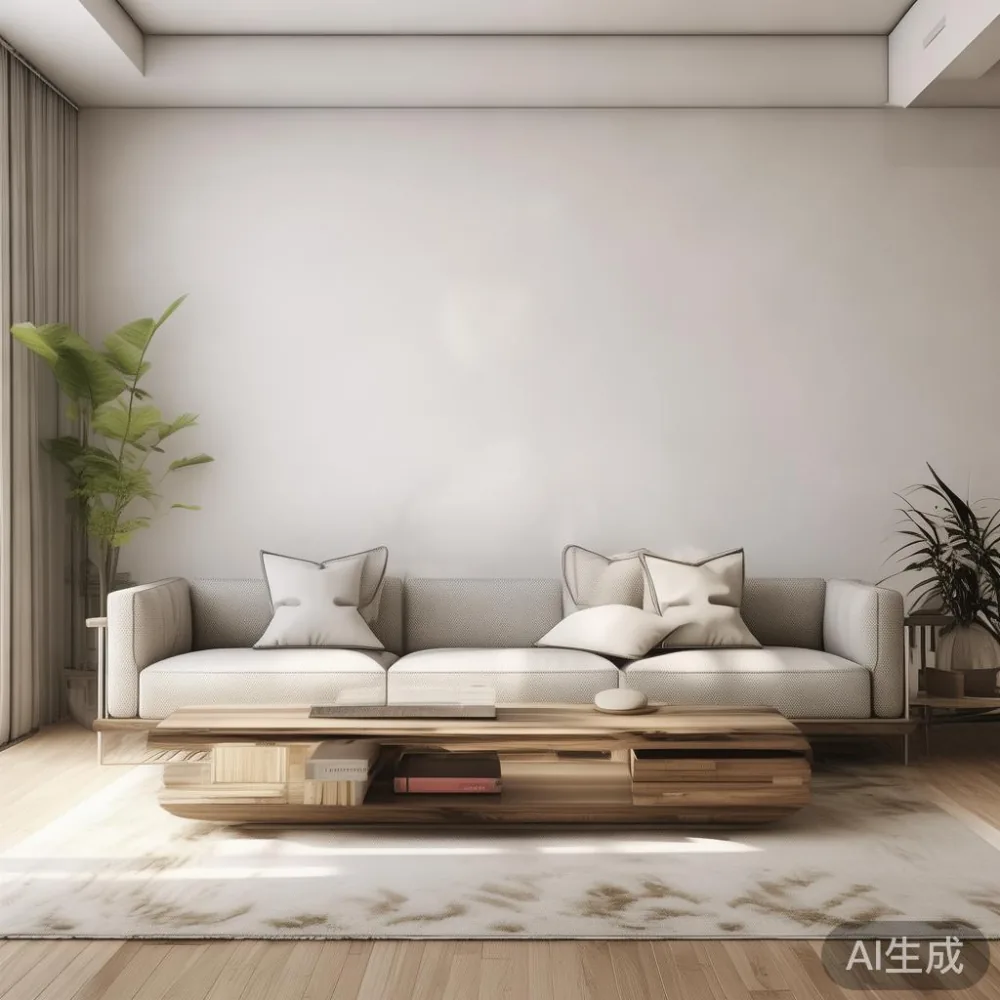
Single three-seater against a wall. The default. Works in any flat from 14 sqm upwards. Pair with a 120 cm marble table in front and a slim European light luxury TV console along the opposite wall. Leave a 90 cm walkway between the sofa and TV console so a standing adult does not feel cramped.
L-shape with chaise on the short wall. Best for 5-room flats around 20 sqm. The chaise end measures 160 cm to 180 cm and should sit on the wall opposite the door so the entry path stays clear. Avoid L-shapes longer than 280 cm — they swallow the room.
Two-piece modular outdoor sofa as a sectional. My current preference for new-build Punggol flats. Two outdoor sofa modules of 140 cm each, joined at a 90-degree corner, give you 280 cm of seating that still fits through a single HDB lift because each module is below 150 cm in any dimension. Add a third module later if the household grows.
What Should You Do Before Clicking Buy?
Run through this six-point checklist before you commit. If any answer is no, slow down.
1. Have you measured the lift depth and door height of your block? 2. Have you taped out the sofa footprint on your living room floor? 3. Have you confirmed the heaviest single package weight is under 25 kg if there is no service lift? 4. Have you checked that the seat height, depth, and back height all match your household's needs? 5. Have you confirmed the warranty covers at least 10 years on the frame? 6. Have you budgeted for the 9% GST and any delivery surcharge?
If you can answer yes to all six, the sofa will probably fit, survive the delivery, and serve your family for the next decade. If you answered no to any of them, take another weekend to measure. A sofa is too heavy and too expensive to ship back if you guessed wrong — Singapore's 14-day return window does not always cover freight on a 60 kg carton.
Final Thoughts on Sizing a Sofa for a Singapore Home
The right sofa size for an HDB living room is a balance between wall length, lift access, household needs, and the look you want to live with for the next ten years. Most three-seaters between 200 cm and 230 cm will work for a 4-room flat, while 5-room flats can stretch to 240 cm or to a modular configuration. Outdoor sofa designs, with their lighter modules and weather-resistant solid wood frames, solve more HDB access problems than most buyers expect — a point worth considering if your block lacks a service lift.
If you want a specific starting point, look at three references that capture the spirit of what most Singapore customers end up choosing: a French light luxury frame for smaller HDBs, an american sofa set design for larger family flats, and a modular outdoor configuration for tight-access blocks. Each of those directions maps to a different living room size and household rhythm, and getting that match right at the start will save you a re-delivery, a refund request, or a scratched corridor. Take the measurements, tape the floor, check the warranty, and only then commit to the sofa that will quietly shape your home for the next decade.